Pakistan through history and culture

A trip to the National Museum of Pakistan in Karachi and Thatta for a dose of archaeological treasure…

Our trip to Pakistan last January turned out to be a culturally enriching journey and we thought it would be nice to document some of our experiences and observations. We found Pakistan a place of historical and cultural diversity with much to offer beyond the usual image projected.

We were determined to show the children that there is more to Karachi than “hot bazaars and lots of people”; their rote response when quizzed about the city. So, we thought it would be a good idea to take them to the National Museum of Pakistan for a dose of culture and history and subsequently change their impression of the city.

In 1970, the museum relocated from Frere Hall to Dr Ziauddin Ahmad Road and is under the auspices of the Department of Archaeology and Museums. Nestled in a surprisingly peaceful oasis, the ornate façade of the building forms a backdrop to people having their lunch in the gardens on the grass. The museum is pleasantly unique in its architecture. While most museums are entirely indoors, a colonnade on the upper level provides a charming outdoor aspect from which the galleries branch off.

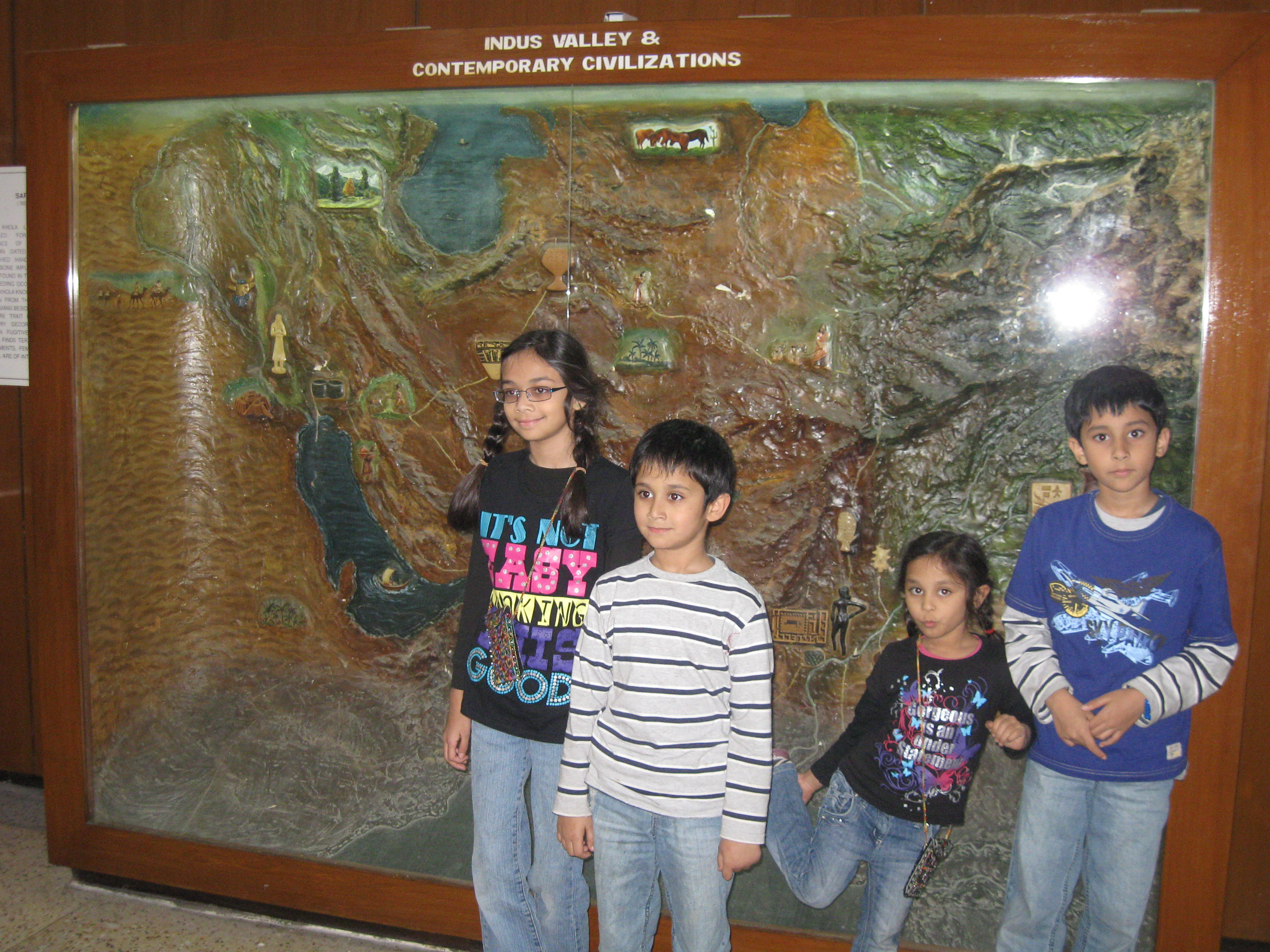
The building houses artefacts which span from 2,000,000 years ago to contemporary civilisation. Such is the expanse of history attributable to parts of The Subcontinent. Life-size relief maps locate the various Indus River Valley Civilisations, such as Periano Ghundai (3500-2000BC), Moenjodaro (2500-1500BC) and Harappa (2100-1600BC). Various aspects of life are represented through accompanying miniature models, which are particularly eye-catching to children. Amongst the numerous archaeological treasures are earthenware jars and vast collections of coins belonging to various Mughal dynasties, with some dating back to the 6th century BC of the Indo-Greeks, Scythians and Parthians. Ethnological galleries include life-size representations which show village life, their handicrafts and dwellings, and everyday dress and costumes, together with some exquisite jewellery. Relating to the Independence Movement, there are items of furniture, paintings, and photographs of political figures and items of clothing of Jinnah. Buddhist, Hindu and Islamic artefacts are testament to the various religions of The Subcontinent to which both Pakistan and India have played host since ancient times.

It is indeed fortunate that this little museum brings to life the vast number of civilisations dating back 2,000,000 years. On our visit, it struck us that the museum could be enhanced with some potential changes. Most of the artefacts had accompanying explanatory plaques; however, some didn’t. Unfortunately, this gave a feeling of inconsistency. Also, the overall display of items would be improved with better lighting. Airtight cabinets would protect priceless and irreplaceable items from moisture damage and general deterioration and ensure their preservation for future generations.

To make a museum visit more appealing to youngsters is to make it an interactive and fun experience. Other museums have had success with kids’ Q&A worksheets in the form of questionnaires and various activity booklets to be filled in throughout the visit with a small reward at the end.

As our cultural heritage site, we chose to visit the city of Thatta. It was the capital of Sindh from the fourteenth century till 1739 and is known for its historic monuments. These are also listed among UNESCO’s world-heritage-listed sites. See: http://whc.unesco.org/en/list/143

There are two main famous areas in Thatta. First, the tombs at Chaukundi, the necropolis of graves at the Makli Hill, where several Tarkhan and Mughal officials are buried. The graves are made of solid rock and are embossed with beautiful calligraphy from the Quran. Admiring these graves reminds one of the impermanence of life and the finality of death. Second is the Shahjahani Mosque, which is the main mosque of the city and was built by the Mughal emperor Shah Jahan as a gift to the townspeople for their hospitality shown to him. It is adorned with exquisite blue and white tile work designed like a mosaic and fortunately these vibrant colours have withstood the test of time. The mosque is also a testament to the grandeur of the Mughal Dynasty, as is the Jama Masjid in Delhi, one of the largest and best-known mosques in India, also commissioned by Shah Jahan.

Today, Thatta is also known for its handicrafts and colourful glass bangles. These artefacts are well known throughout The Subcontinent. The hand-printed fabrics, block-printed clothes, the exquisite embroidery work inlaid with tiny mirrors and the intricately designed glass bangles sold in the bazaars of Thatta entice the tourists and are difficult to resist.

An inspirational occasion was an evening at the Karachi Arts Council, dedicated to the Student Movement of the 1950s called ‘Looking back to look forward.’ This nostalgic journey was made through a collage of slide presentations, short documentaries, impassioned speeches and verbal accounts in person from those who were intrinsic to The Movement. Many artists and poets contributed to this event and a rich vocal performance by Tina Sani stood out as something truly magical, transporting the audience to another plane. The electric atmosphere only heightened once the acclaimed band Laal hit the stage – https://www.facebook.com/laalpak?fref=ts – and it wasn’t long before most of the students in the auditorium were on their feet singing away. Laal are indeed friends of democracy and human rights and are doing a fantastic job of raising awareness of both students and the working class about their rights. Further, by providing the Pakistani youth a platform to express themselves, Beena Sarwar, together with her colleagues, is doing some wonderful work to continue the legacy of her late father, Dr. Mohammad Sarwar. We certainly hope that this canvas with its palette of nostalgia, youthful energy, hope, music, poetry and passion provides a source of inspiration to help them create a bright future for themselves, should they decide to move forward and claim it.

Not long ago, a friend lamented, “…Yes what’s happening in Pakistan at this point is demoralising, but then if you live in this situation, I guess you develop a level of immunity as a safeguard…do not moan and groan so much, and continue to maintain a level of normalcy, but deep down it hurts and you keep having a feeling as if you are sinking!” Despite the gravity of the current situation, events such as this show that people are willing to “maintain a level of normalcy.”

Given the difficult times that contemporary Pakistan is facing, the importance of preservation of cultural and historical treasures in the National Museum Of Pakistan and at Thatta becomes more important than ever. Their presence as icons of pride form part of the cultural and national identity of Pakistan and can be revered amongst current and future generations alike.

Huma Ahmar

Danielle Gehrmann

The version above has some minor modifications. The original article can be found at: 

http://jang.com.pk/thenews/nov2010-weekly/nos-07-11-2010/foo.htm#2

Holiday snapshots from Pakistan

A report on my second trip to Pakistan at the beginning of 2010. On our return, my travelling companion and friend, Huma Ahmar, and I had a lot of fun and laughs writing this:

“Breathe and smile!” This philosophy stood us in good stead during our recent trip to Karachi, as some considered us rather brave travelling with four young children (ages 11-4)! We met up in Hong Kong and travelled to Karachi on Pakistan International Airlines. This was Danielle’s second trip to Pakistan (she wrote about her previous trip for Sada-e-Watan in 2008: “Sydney University students in Pakistan,” http://www.sadaewatansydney.com/students-pk.htm).

Exhausted after the long night flight and transit through Islamabad, we ambled out onto the sun-drenched forecourt of Jinnah International, where we were warmly greeted by Huma’s family. There was an instant sense of familiarity as we were swept up in the chaotic Karachi traffic. We had arrived.

On the second day, we ventured out for a spot of afternoon shopping in Bahadurabad with Bhabi, sister-in-law in Urdu. How fashions can change in two years! Yet, the new styles started to grow on us by the end of the afternoon and we did indulge in some new pieces.

Some exciting events figured in our packed schedule. Three birthdays punctuated our time in Karachi and we managed to stretch them out pretty well too! There was a family dinner at Largess and an afternoon tea, lunches at Lasania and Arizona Grill in Zamzama and cakes galore, of course! Plans were in full swing for a reunion with Huma’s English Department pals from her student days at Karachi University and about 13 of us made it to Roasters in Zamzama. The lively atmosphere grew as everyone was taking a trip down memory lane while having a chuckle about the good ol’ KU days. Usually, when you’re the outsider at these types of gatherings, the stories and jokes tend to be a bit lost on you; but we all had a memorable evening filled with fun and laughter.

An inspiring occasion held at the Arts Council was an evening dedicated to the Student Movement of the 1950s. We were kindly invited by Zakia Sarwar, whose late husband was one of its leaders. The theme of the evening was “Looking back to look forward.” The occasion, in part, paid homage to the collective efforts of many students of the day rallying for their rights across Pakistan; this nostalgic journey was made through slide presentations, short documentaries, impassioned speeches, a rich vocal performance by Tina Sani and verbal accounts in person from those who were intrinsic to The Movement. Reminiscent of students’ politics it took Huma back to her days at KU. The electric atmosphere of the evening was heightened by the time the acclaimed band ‘Laal’ hit the stage (see: https://www.facebook.com/laalpak?pnref=lhc). They are doing a fantastic job of raising awareness of both the students and the working class about their rights and the bright future that awaits them should they decide to move forward and claim it. They are indeed friends of democracy and human rights. As the name suggested, “Looking back to look forward” certainly fulfilled its promise. Beena Sarwar, the daughter of the late Dr. Mohammad Sarwar, is making a wonderful effort of continuing his legacy. She and her colleagues are doing an amazing job of providing a platform for the Pakistani youth to express themselves, something that they need in these challenges times. We wish them luck!

The following day it was off to the beach Pakistani style. West of Karachi, French Beach was the perfect soothing tonic. It was great to see Omayr again, who had been so gracious during Danielle’s 2007 visit. Our group spent the afternoon out on the beachfront merrily chatting away and getting acquainted. After a feast of succulent crabmeat prepared by one of the locals, it was time to sink into the lounges and gaze dreamily out over the Arabian Sea, losing ourselves in more conversation.

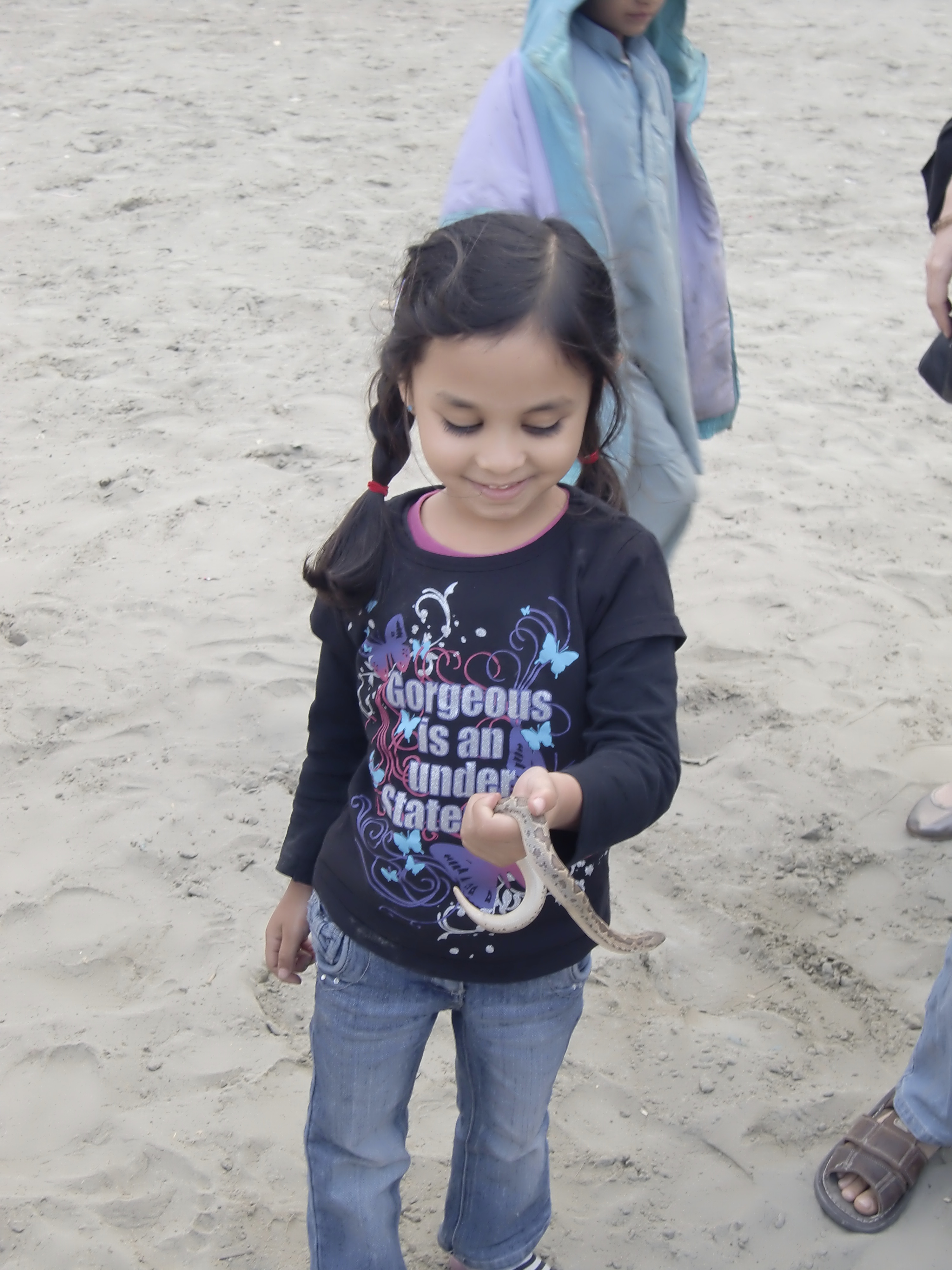
We managed to take the kids to the National Museum of Pakistan to change their impression that “Karachi is a place with hot bazaars and lots of people”, which is their standard response when quizzed about the city. So, after a spot of lunch at Alpha Restaurant and a quick peak in at Zainab Market – we couldn’t resist – it was off to the museum for a dose of culture and history and to learn about the Indus River Valley Civilisations, the Mughal Dynasty and Quaid-e-Azam. So-called ‘normality’ then returned when we headed to Clifton Beach for a heady mix of camel and horse rides and snake charmers by sunset. Only in Karachi! The four year old took a liking to a very cute “baby snake” that the snake charmer had brought out to show; but a meltdown nearly occurred when informed that she couldn’t take it home with her. Thankfully, it was averted with chocolates.

Huma’s father wanted to take the whole family on a day trip outside Karachi and Thatta was chosen as a place of historical interest. It is a city known for shrines of the various dynasties that once presided over the landmass that is now Pakistan. He was fortunate enough to get a special pass and we indeed felt privileged to have the opportunity to visit this area and learn something about important bygone epochs. The tombs at Makli remind one of the intransience of life and the permanence of death. The fine workmanship and the vibrant colours have withstood the test of time. It was a picture perfect day as the bright, clear sun, cloudless, blue sky and golden, sandy colour of the stone provided a striking landscape to photograph. Our next stop was the beautiful mosque in the town centre built by the Mughal Emperor Shah Jahan in the Fifteenth Century to thank the townspeople for their hospitality while he was staying there. What a generous gift!

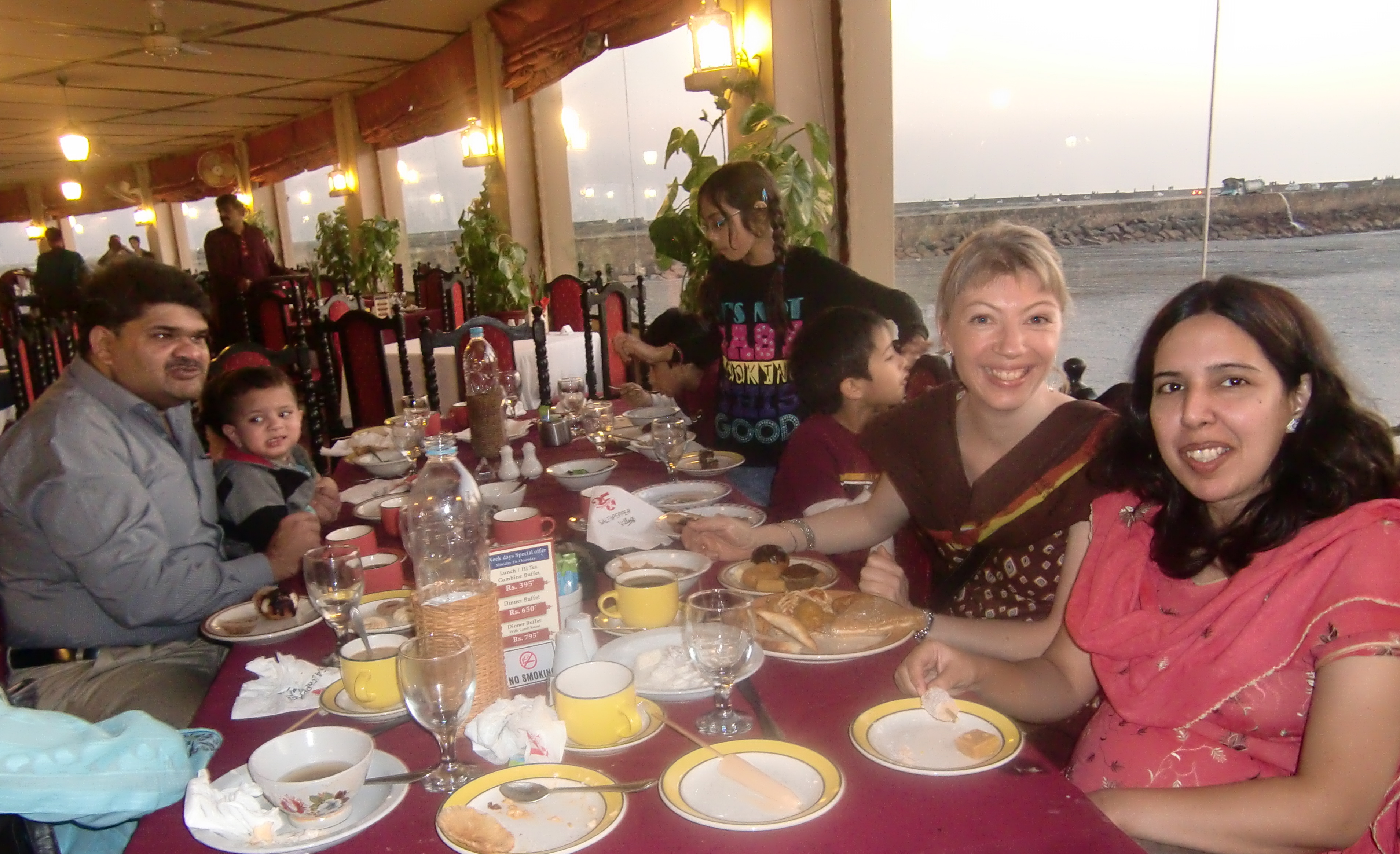
The end of our stay was drawing nigh, so the pressure was on to fit in all our shopping as there were a few gifts to pick up for people at home and we were both in need of adding to our bangle collections. Our friend Farah was obliging and offered to take Danielle to all the right places. We picked up pretty much all we needed at Gulf Market before moving on to Jafferjee’s, the place known for its quality leather goods. After making a pit stop at Butler’s in Zamzama to pick up some delectable chocolates, we joined the family for high tea at The Village at Seaview.

Now, what trip to Pakistan would be complete without getting mehendi done!

Uzma and Danielle caught up one last time for coffee at Butler’s and before we knew it we were being pushed into a rickshaw with a reassuring: “Say no more, I know someone”, and off we flew to the parlour.

Hectic was an understatement! Those 12 days were certainly an unforgettable adventure! So many things to do, so little time. Unfortunately, we still left some disappointed faces in our wake. The front door felt like a revolving door at times and the phone seemed to ring non-stop; no sooner had people waved goodbye than the phone rang and some others were on their way round. We slotted in numerous visits to the homes of family and friends new and old; and well, we did leave some things undone; so we’ll just have to readmit those to the ‘to do’ list for our next visit.

The original link can be found at: 

http://www.sadaewatansydney.com/unistudentspakvisit2010.htm

The version above has some minor modifications.

CIMG4145CIMG3997CIMG4177IMG_0453Appiya and family 183CIMG4074CIMG4029CIMG4117CIMG4122CIMG4376IMG_0477DSCN3432CIMG4323