Sydney students visit Pakistan

Back in 2007, when only a handful of people had anything complimentary to say about Pakistan, some intrepid students discover a delightfully different reality

When one of our lecturers from The Department of Linguistics at the University of Sydney asked six students: Emily Hunter, Jane Harvey, Jana Rezková, Sandy Chang, Yuka Funabashi and I if we would be interested in accompanying him to Pakistan to present our various research papers at the 23rd annual Society of Pakistan English Language Teachers (SPELT) conference, we jumped at the opportunity. While most of us were busy preparing our end of semester papers, the excitement was quietly mounting beneath the manic exterior; for I think now, we all sensed that a unique experience was about to happen.

On arrival at Jinnah International on 1 November 2007, we were whisked away by our surrogate family to the comforts of our new surroundings. We barely had time to catch our breath before being initiated into the frenetic Karachi traffic. First port of call was Bahadurabad to get us attired in shalwar kameez: the three-piece outfit consisting of loose-fitting pants, shalwar, a long tunic or kameez, and a long, flowing scarf called a dupatta. Not ever having seen so many bright colours in the one place before, well, let’s say we were spoilt for choice. As well, it turned out to be an exercise in patience on the part of our lecturer in taking six women shopping! Next stop came our introduction to Pakistani cuisine: the roll kebab. And we were hooked. After many squeals emanating from my colleagues on the trip home, due to the likes of traffic they hadn’t ever witnessed before, we finally collapsed into an exhausted heap, only to be awoken at sunrise by the call to prayer and a welcoming “as-salaam walaikum” as we wearily found our way downstairs to breakfast.

Our days were a mixture of conference commitments, presentations at Karachi and Aga Khan Universities, teamed with site-seeing escapades: camel rides and snake-charming on Clifton Beach while taking in the magnificent sunset; shopping; a visit to Mohatta Palace followed by high tea at The Village, a spot of sheisha at Seaview and more shopping intermingled with numerous visits to the homes of new-found friends. Then there was the very swish soirée hosted by the British Council. Students never had it quite so good! On the final day of the conference when all the formalities were said and done, we managed to escape to the cool of the Prince Theatre to see the acclaimed movie Khuda Kay Liye, In the Name of God, which we all enjoyed immensely for its cultural value.

Along the way, we, the PAC (Pakistan Adventure Club), adopted many names for ourselves: the brood, the kids, the gang, the family; these pseudonyms formed part of the invisible glue binding us together through our new shared experiences.

Since the conference was a moveable feast, the next destination was Abbottabad, which we reached courtesy of PIA through Islamabad. Unfortunately, we didn’t see a lot of Abbottabad itself, but that was counterbalanced by the enthusiastic welcome and generous hospitality offered by our hosts. Leaving Abbottabad, we drove through some magnificent landscape of dramatic gorges and mountains before stopping for lunch in charming Nathia Gali, then onto Murree for more delicious food and naturally more shopping. Since our arrival in Islamabad coincided with Benizir Bhutto’s, as well as the fact that there was a demonstration due to be held the following day, the conference had been cancelled and the city was more or less in lockdown. However, after the security alert had been relaxed, this only gave us the green light for further site-seeing adventures, always accompanied by our generous hosts. We concluded our visit with our presentations at Fatima Jinnah Women’s University in Rawalpindi before departing by bus for Lahore.

Lahore was something else; a city steeped in history. On our ‘must-see’ list was the Wazir Khan Mosque, since it was one of the scenes featured in Khuda Kay Liye; and what visit to Lahore would be complete without looking in on the breathtaking Lahore Fort! Being a Sunday, there was a throng there. We, ourselves, at times became the tourist attraction; the locals just as intrigued by us as we were by them. We befriended Omayr who happened to be staying at the same guest-house as us. Lucky for us he turned out to be a Lahorite and offered to chauffeur us around. Our calendar consisted of dinner at Cooco’s Den and Café, sheisha at Jumping Java, a visit to the magnificent Shalimar Gardens, and our final lunch as ‘a family’ at The Village. Sadly, Jane and Sandy had to depart for the real world. All good things must come to an end. What we had lost though in numbers we made up for in enthusiasm.

Warm faces welcomed us wherever we went and Multan was no exception. After presenting our papers for the final time at Bahauddin Zakariya University, a delicious surprise awaited us; we were transported by car through lush agricultural land to where we took a boat to one of the islands in the middle of River Ravi. What we then feasted our eyes on was nothing short of a scene out of 1001 Arabian Nights. A sumptuous meal had been prepared by the wife of one of our hosts, which we enjoyed in our tent seated on plush carpets. What enhanced our magical experience occurred on our return trip to the mainland. Since the current was strong enough to propel the boat in the desired direction, the engine was switched off, allowing us to drift silently in the hazy darkness. Yet another memorable event was an afternoon shopping expedition stopping off for periodic cups of doodh-patti (milk tea) before our de rigueur foray into the world of bangles – a thrilling event in itself.

What an incredible adventure we had! All in all there were late nights and some very early mornings. Every wink of sleep lost was worth its weight in gold; we wouldn’t have missed any of it for the world; and for the heart-warming welcome we received wherever we went: Shukriya, Pakistan!
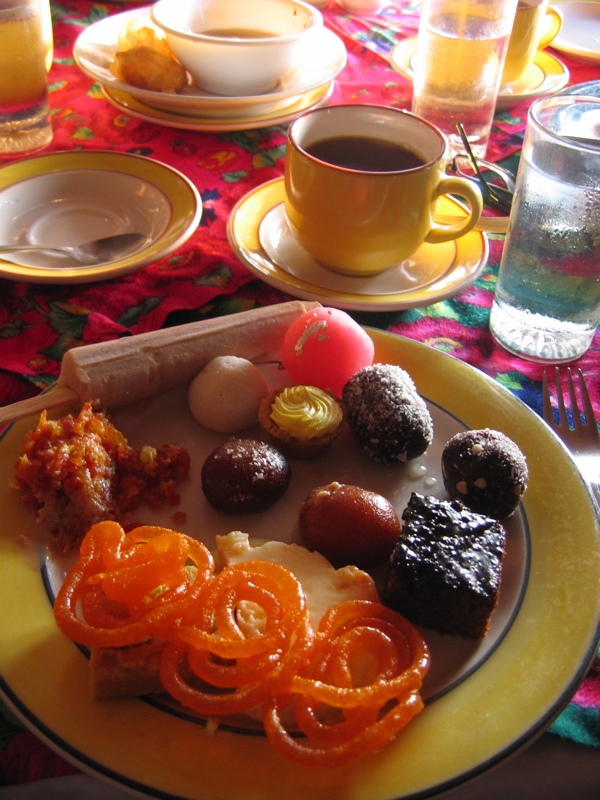
Karachi: high tea
High tea in Karachi with the sweetest of sweets
Karachi University
At Karachi University: making connections
Some of the conference presenters and organisers
Abbottabad
Abbottabad
Lahore: Wazir Khan Mosque
Atmospheric Lahore: at Cooco's Den and Cafe
Atmospheric Lahore: at Cooco’s Den and Cafe
The happy gang explores the Lahore Fort
Multan: 1001 Arabian Nights
Multan: showing off our bangles

Danielle Gehrmann

The above above has some minor modifications. The original article can be found at: http://sadaewatansydney.com//students-pk.htm


Memories I live and breathe – the call to Pakistan

In this article, I take an introspective journey and consider my collective memories of my long-time relationship with Pakistan, and its dynamic contribution to our contemporary world.

Judge a moth by the beauty of its candle.

Shams is invisible because he is inside sight.

He is the intelligent essence

Of what is everywhere at once, seeing.

Rumi

Pakistan tends to be a rather misunderstood corner of our planet, with a plethora of negativity and associated images emanating from international mass media. Undoubtedly, such an overrepresentation has contributed largely to a somewhat distorted image of the country. Through my first-hand experiences, I have subsequently sought to fill this enormous gap, with an aim to provide information and present this oft-maligned place in a more balanced way. Somehow assuming the role of accidental brand ambassador, I have found myself reporting on aspects of the country, which are often overlooked and shielded from the international eye. My writings have ranged from hard political, economic, and diplomatic to the more light-hearted. Yet, my attempts to present a Pakistan beyond the media stereotype have frequently been met with resistance. Further, my visits seem to have placed me in the precarious position of bringing a non-Pakistani voice to the table and consequently attracting criticism for such an ‘idealistic’ stance, as well as several rebukes for even visiting the country in the first place, given “The way they treat their women!” Sometimes, even I find the ignorance astounding: “Is that safe?”; “I thought everyone would be in a burqa!” while I’m left to explain that the dress code for women in Pakistan is largely not as in Iran or Afghanistan. Despite Pakistan being home to two Nobel Peace Prize laureates, including the youngest-ever, Malala Yousafzai, somehow the reality of many Pakistanis as urban, well-educated, ambitious, upwardly mobile, dynamic, and many with a strong entrepreneurial spirit, is getting lost in the fray. 

Frere Hall: Nineteenth Century architecture

No matter the amount of television news reports you see or articles you read, nothing heightens your sensitivity toward a place more than first-hand experience. My well-considered opinion is that Pakistan receives a lot of bad press and, frankly, deserves better.

The journey starts in 2007, when, as a student, I was invited to present a research study at a language-teaching conference, along with five other students from the University of Sydney. Our travels all over the country turned out to be a life-changing experience. My second visit was at the end of 2009, when a friend invited me to join her and her family for the end-of-year holidays. In 2012, a couple of brother-sister friends from Sydney decided to have a double wedding extravaganza in Karachi and it was such an honour to share in their happy occasions. In 2015, one of my best friends married in Karachi; the pre-wedding preparations were certainly fun, yet nerve-raking at the same time. The most recent visit, in 2019, was at the invitation of a friend in Lahore for his wedding celebrations. And the difference between a Punjabi wedding and a Karachi wedding really struck me!

Beyond purely social engagements, I manage to give at least one talk every visit; and in 2019, I spoke to some very engaging high school students in Lahore. I have previously appeared on a talk show for PTV World in Karachi. In Australia, I give occasional talks and enjoy attending functions to further Australia-Pakistan relations. Throughout those five visits, I have developed an affinity for colourful fashion and handicrafts; whether a Sindhi wall hanging with inlaid mirror work given to me by a friend in Karachi; a beautiful woven carpet from Lahore; a hand-made wooden- and silver-framed mirror, plus some leather and cowhide cushions, all take pride of place in my home. For special occasions, I like to wear “Made in Pakistan,” whether a striking shawl or one of my bespoke pieces by a designer friend in Karachi, co-ordinated with bangles and other fun pieces of which I have amassed quite a collection. A handbag by an iconic local leather goods brand has turned into a favourite and nearly always attracts a compliment every time I use it. There’s a little bit of Pakistan fairly close by at any given moment.

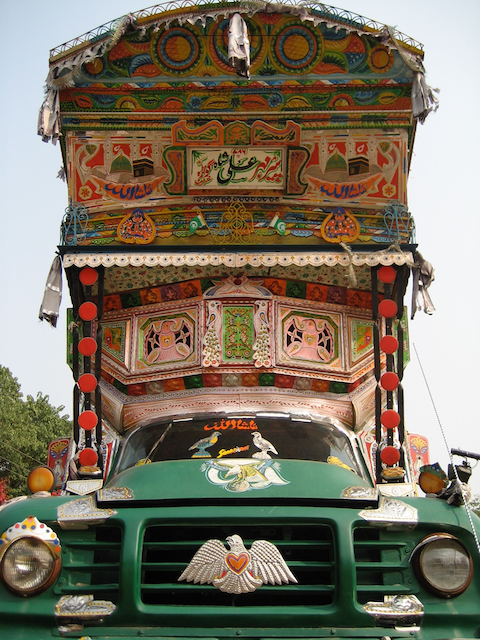
Distinctive Pakistani truck art

As much of the world is emerging from a harrowing couple of years since the start of the COVID19 pandemic, there is renewed excitement in the air. On the whole, Pakistan has fared well in the management of the pandemic, thanks to gold-standard tracing and record keeping developed during the polio vaccination drive. And I’m feeling the pull, back to Pakistan to reunite with friends who have become like family and experience more of the five Fs: friends, family, fun, fashion and food – khana: the most important word in Urdu! Overwhelming generosity and hospitality, historical treasures, archeological sites, the varied perspectives of multicultural Pakistan from the eastern areas of Punjab across to Balochistan towards Iran, each with their own identities uniquely expressed through differing customs, styles of music and varied spices used in their respective cuisines will captivate even the most discerning traveller and mesmerise you like a snake charmer on Clifton Beach, in Karachi. You, too, will submit.

A Punjabi wedding: a once in a lifetime experience – Lahore, Lahore hai!

On my last visit, I vowed to venture up north on my next visit. We had a glimpse of Pakistan’s striking northern beauty when we stopped in delightful Nathia Gali en route from Abbottabad to Islamabad, in 2007, and so the Himalayas are a huge draw card for the next trip. At the top of the list are Chitral, Mingora, Swat, and around Hunza, Skardu, and Gilgit. For geology enthusiasts, Pakistan is home to the second largest salt mine in the world: the Khewra Salt Mine, a prime tourist attraction, located in the province of Punjab. Thanks to policy reforms in recent years, rest assured that this kitchen staple will reach you directly from Pakistan. 

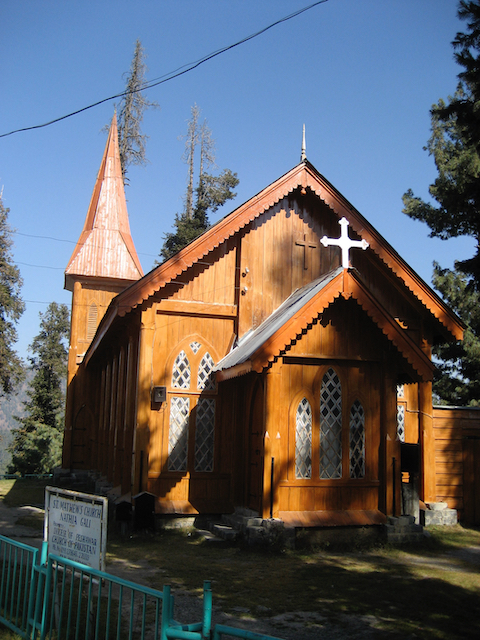
St. Mathew’s Church, Nathia Gali, built 1914

My memories are, indeed, vivid and wonderful, past and present, and fill me with warmth and gratitude for all the amazing friendships and connections forged throughout the years; and every time I return, the memories and friendships just keep getting more wonderful and more amazing. It certainly feels like the time is ripe to relive some old, treasured memories and create some new ones!

Danielle M. Gehrmann

The above version has some minor modifications and hyperlinks, which were missed in the original publication at: https://dnd.com.pk/memories-i-live-and-breathe-the-call-to-pakistan/261245

All photos are from my personal collection.

Acknowledgement: Much appreciation to Brigadier Shoaib bin Akram for his patience, generosity, and assistance in the publication of this article.

Letter to Cricket Australia

A cloud of doubt over the Australian Men’s Cricket Team’s tour to Pakistan in early 2022 prompted the following letter.

Subject:          

Upcoming tour of Pakistan by the Australian Men’s Cricket Team

Dear Mr. Hockley, Executive, Mr. Freudenstein, and board members,

I am writing to you in relation to the Australian Cricket Team’s upcoming tour of Pakistan in February 2022.

I had written the following letter during the last week of October and was waiting on a few more signatures; but, we are now all overjoyed with this week’s news of Cricket Australia’s decision to proceed with the tour of Pakistan in early 2022.

England’s recent withdrawal from the tour to Pakistan and New Zealand’s abandonment of the tour after having arrived had left many disappointed and disillusioned. In particular, the reneging on reciprocal contractual obligations by the English Men’s Team has understandably left the head of the PCB feeling frustrated and resentful as noted by Ali Martin in his article for The Guardian.

Cricket Australia and the Australian Cricket Team are now uniquely placed to rise to the occasion in the international cricketing community, as well as to make the 90,000-strong Pakistani diaspora in Australia extremely proud and happy for both teams by proceeding with the tour.

As a five-time visitor to Pakistan between 2007 and 2019 and accidental brand ambassador, I am in a strong position to testify to the overwhelming hospitality accorded by Pakistanis. Indeed, SMH journalist Andrew Wu affirms that visiting teams are given the royal treatment, with commensurate security. The Duke and Duchess of Cambridge visited Pakistan toward the end of 2019 without incident. Further, the Pakistan Cricket Team visited New Zealand in 2020, after massacres in two mosques in Christchurch in 2019, as well as enduring compliance with COVID19 quarantine regulations.

Several photos in my albums depict Pakistanis’ passion for cricket: young boys setting up a wicket on the street outside the Mohatta Palace in Karachi and, too, outside the Wazir Khan Mosque in the Old Town in Lahore. Any place is a great place to bat up.

Impromptu game in the old town in Lahore
Photo credit: Danielle M. Gehrmann

Despite general, negative perceptions about the country, Pakistan has weathered the COVID19 storm infinitely better than neighbouring India, thanks to gold-standard contact tracing systemised during the polio vaccination drive, plus it has submitted to a relatively low percentage of mortalities, at .01%, compared to India, at .03%, to date.

During this time, as many countries emerge from COVID19 with a sense of renewed hope and rejuvenation, so many wish to grasp some positivity and enjoy life again. And a visit by an international sports team will unfurl economic advantages for a decimated local economy.

Compared to UK and US, Australia and Australians are perceived relatively positively in Pakistan; yet, after some recent faux pas on the world stage by Australia’s incumbent leadership, some positive PR via soft diplomacy will be of immense value to Australia’s less-than-glowing reputation.  

In light of an active anti-Pakistan campaign to make the country a scapegoat for abject failures of USA and its allies in Afghanistan, Cricket Australia has a unique opportunity to show leadership, mend rifts and bridge divides – to hit the reset button. The power of people-to-people contact should always be highly valued. Excessive jitteriness over travel to Pakistan only serves to perpetuate divide and negativity. Pakistanis and the PCB deserve to be treated with sincerity and without condescension.

Such a unique opportunity to play a vital, pivotal role in Australia-Pakistan relations, as well as for the wider cricket community will afford unquestionable mutual benefits.

Congratulations on making the right decision. It’s a win-win.     

Yours faithfully,

Danielle M. Gehrmann – www.daniellegehrmann.com

Saleem H. Ali – Honorary Professor, Sustainable Minerals Institute, University of Queensland

Zushan Hashmi – Co-founder, Sportageous

Jeremy Higgs – COO, EcoEnergy

Shaan Zaidi – Chairman, CyberHub

I have a dream…

My friendship with Pakistan dates back to 2007, when I travelled there for a conference with a group from university. I returned in January 2010 to reconnect with ‘family’ and friends and experience more cultural and historical gems; the seemingly endless generosity and hospitality is just an added bonus.[1]

It’s apparent that Pakistan receives, on the whole, some pretty bad press on the international scene. With an aim to present a Pakistan beyond the media stereotype(s), I started to write about my trips on the nudging of a journalist friend. It may, and still does, come to many people’s surprise that I do not, nor have I ever had any reservations about visiting the country. If I believed even half of what was splattered over the nightly news, I doubt I would have gone there in the first place. After all, we are all aware how news media can sensationalise a news bulletin in order to sell an idea or perpetuate an ideology. Why didn’t I believe all those ‘shocking’ news bulletins and headlines? Well, who does believe everything they hear? There must have been a voice in the back of my head urging me to look past the media hype. A friend terms it, “the demonisation of Pakistan by the western media.” Noam Chomsky simply calls it “propaganda.”[2]

Not once have I ever felt uneasy, insecure or in a threatening situation in any part of the country. We have been to Karachi, Abbottabad, Islamabad, Lahore, Murree, Nathia Gali, Multan and Thatta. Yet, I also realise that friends, hosts and people accompanying us keep their ear to the ground and are familiar with which areas and parts of cities to avoid. This is part and parcel of travelling in Pakistan; not something to get worked up about.

A few days into our visit in November 2007, General Pervez Musharraf sacked the Chief Justice, dismissed the judges from the Supreme Court and imposed emergency rule. Family members of our group were sending nervous emails concerned for our safety, thinking we must be in imminent danger, which couldn’t have been further from the case. We were, in fact, enjoying the sights and sounds of Karachi in between conference commitments. Further, our visit to Islamabad coincided with Benazir Bhutto’s return to Pakistan. On arrival into the city, there was a strong army presence on the street and we learnt that a curfew had been imposed. A couple of hours later, it was lifted and our group then headed out to explore the city – business as usual.

Unfortunately, the list of cases which add fuel to so-called anti-American sentiment grows: Raymond Davis; ‘Memogate’; the issue of drones; plus the arrest of a US citizen in February at the airport in Peshawar for carrying live bullets in his luggage. Further, the American government has a distinguished resume outlining its accomplishments: Korea, Vietnam, Afghanistan, Iraq; and they satisfy well the criteria of meddling and interference in other countries’ affairs, dragging a few others into the fray along the way; but delving further into US foreign policy lies outside the scope of this short piece.

Broadly speaking, people are very quick to make judgments and draw conclusions based on one’s appearance and without knowing you personally. I too have been guilty of this over the years; but I’m working on correcting such a shortcoming! Both my mother and travel have taught me not to draw conclusions about people based on broad-based assumptions. Further, I reject stereotypes, learning long ago that they don’t exist – really they don’t – and to take everyone as an individual. I abhor pack mentality; and any form of discrimination stemming from one’s cultural, religious or ethnic background. Embracing diversity, we can all learn from each other and further, draw some inspiration from Dr. Martin Luther King’s famous ‘I have a dream speech’ and apply it to our own situations. One of my mantras is to take people on their actions and by the content of their character.

Recently, however, there are some in and outside Pakistan who become nervous at the idea of a visitor to the country. While their concern is appreciated to a certain extent; in my opinion, it is unnecessary and such an overreaction only serves to taint the image of the country further. In short, I believe they are doing Pakistan a broader disservice. It’s undeniable that the country has its fair share of problems. What country doesn’t; but let’s not blow things out of proportion. In my opinion, the more people who travel to Pakistan, whether for work- or travel-related reasons, the more it will help to dispel any negative stereotypes from either side. In turn, visitors will assist an economy that is in dire need of a cash injection that will directly benefit people and communities, rather than being misdirected by the government, as funds currently are. A taxi driver who mumbles that all Americans should be blown to smithereens doesn’t mean that he will actually do it.

The thing is, I’m not American. I think that’s what stings the most! It almost feels as if Pakistan has indirectly rejected my presence, more recently, through no direct fault of my own. It is important to maintain a distinction between a government and its citizens, whose primary concerns and agendas are usually rather distinct. Suddenly, I feel like a victim; whereas I empathise with Pakistanis, as a collective, and how victimised some of them must have felt over the last 10 years or so through increased visa restrictions or outright rejections – particularly when wishing to travel to so-called ‘western’ nations – and random checks at airports, for example.

My aim is to discontinue the myth that Pakistan is in complete meltdown all over the country at any given hour and to dispel general paranoia from both a Pakistani and so-called ‘western’ perspective. Yes, there is some unrest periodically, but so can there be anywhere. Any ‘street’ disturbances are limited to a particular area of a city and are not indicative of across the entire city. As an Australian based in Karachi for a few years now asserts: “As normal in Pakistan, life goes on…” Even with upcoming elections, another friend in Karachi doesn’t foresee the next few months to be especially bad.

Believe me, the main threats a visitor faces are being killed with kindness and a caffeine overload from too many cups of tea; some inquisitive stares and, of course, getting stuck in a traffic jam. That’s the Pakistani way!

Pakistan 176

[1] Accounts of both trips can be found at: http://www.sadaewatansydney.com/unistudentspakvisit2010.htm

[2] Chomsky, N. (2002). Media Control: The spectacular achievements of propaganda. New York: Westfield.

The version above has some minor modifications. The original article can be found at: 

http://www.speakforchange.org/i-have-a-dream-pakistan/

Building bridges with peace parks

We all have to start somewhere and why not start with the citizens in the case of India and Pakistan

An instalment of ‘Conversations’, the ongoing email exchange between an Indian and a Pakistani journalist in this newspaper included a discussion on war memorials and peace parks, and the notion of such memorials and parks in India or Pakistan, or potentially a joint venture as a path to reconciliation (‘Push for peace parks,’ Aman ki Asha page, Political Economy section, Mar 28, 2010).

The inspiration stemmed from some precedents already set, hinging on universal philosophies of peace parks as places of introspection, reflection, greater understanding and healing. For example, the one between Israel and Jordan, the one running along the former Iron Curtain and a proposal for one between the Greek-Cypriot and Turkish-Cypriot territories, which incidentally would be more vital than ever given Cyprus’s recent election results.

Initially, I found the idea rather jarring – pretty out there and even alien. Then another example sprang to mind: the ANZAC (Australian and New Zealand Army Corps) Commemorative Site at the Gallipoli Peninsula (Gelibolu) in Turkey. During the First World War, a protracted military campaign took place mainly between the Australian, British, and New Zealand forces and the Turkish Army. An annual dawn service is held there to commemorate the bravery and sacrifice of the ANZACs.

Many say that these battles left an indelible mark on the Australian psyche and have become a large part of Australia’s national identity. Even though all the Australian First World War veterans have passed on now, the numbers of attendees are increasing every year at the Gallipoli dawn service. ANZAC Day parades are held in most Australian cities and descendents of First World War veterans have been given permission to participate in place of their deceased relatives, proudly wearing their medals.

Due to the increasing number of people making the pilgrimage to Turkey, the Gallipoli Peninsula underwent extensive excavations and rebuilding between 1999 and 2000 through a co-operative process between the Turkish, Australian and New Zealand governments: http://www.anzacsite.gov.au/3building/

On the tiny beach affectionately called ANZAC Cove, where the ANZACs landed at dawn on 25 April 1915, an enormous epitaph is inscribed with the moving words:

“Those heroes that shed their blood

and lost their lives…

You are now lying in the soil of a

friendly country.

Therefore rest in peace.

There is no difference between

the Johnnies

and the Mehmets to us where they

lie side by side

here in this country of ours…

You, the mothers,

who sent their sons from far away

countries

wipe away your tears;

your sons are now lying in our bosom

and are in peace.

After having lost their lives on this

land they have

become our sons as well.”

–Atatürk, 1934

The writer of these lines was the Turkish commander at Gallipoli, Mustafa Kemal who later became Mustafa Kemal Atatürk, the founder of the Republic of Turkey and its first president. Atatürk means ‘father of Turks’. It could be said that he played a similar role to Mohammad Ali Jinnah Quaid-e-Azam in the creation of Pakistan.

On a visit to the Gallipoli Peninsula some time back, I felt a sense of unification about the whole place. The Lone Pine cemetery set up on the hill above Anzac Cove has a Wattle Bush, which is an Australian native flower. This addition gave the whole place a further unifying feel.

These days, Turkey and Australia have remarkable political and diplomatic relations. At the time of the First World War, Australia was allied with the British forces and, along with New Zealand, became involved in the war effort due to its close ties to Britain. Some would say that Australia’s involvement in the war was therefore a case of ‘guilty by association’; nonetheless, if it weren’t for their enemy status at one time, perhaps the ‘friendship’ wouldn’t be so strong today. In other words, this shared historical enmity seems to bond the two countries today in such a way that if they hadn’t have been through this, then this sense of fraternity would not be so vibrant.

Two further examples come to mind: first, Japan and Australia were enemies during the Second World War. Despite some existing tensions with regard to Japan’s involvement in whaling, on the whole the two countries enjoy strong economic, commercial and cultural ties.

Second, the recent plane crash on Russian soil and subsequent deaths of many of Poland’s highest government officials, including its president, appears to have been a catalyst in the thawing of Polish-Russian relations; united in tragedy. We all have to start somewhere and why not start with the citizens, in the case of India and Pakistan?

A friend recently reminded me of the relatively new social networking media in our midst, such as Facebook and Twitter to name a few. These have become invaluable social tools, connecting people all over the world. So, why not get the citizens of India and Pakistan connected? From little things big things grow.

The examples of Turkey and Australia, Japan and Australia, and the recent positive development in Polish-Russian relations suggests that shared bonds of enmity do not exclude a future productive relationship between two countries. There is hope.

The version above has some minor modifications. The original article can be found at: 

http://jang.com.pk/thenews/may2010-weekly/nos-09-05-2010/pol1.htm#10

Beyond the conditioning

The email was brief and to the point:

Dear Danielle,

If Pak stops sending murderers to India things will improve.

Thanks,

Raj*

I was pleased to receive this comment, because it showed the writer had read the piece and thought about it. Unfortunately, he hadn’t understood my main premise: that citizens can’t be held responsible for the policies of politicians and the misdemeanours of a few.

I wonder if he’s heard of the Amistad, a project that aims to establish constructive communications between the people of Cuba and the United States. The politics of both countries continue on a divisive course; however, there has been some relaxing of visa restrictions between the two countries in recent months, paving the way for people to see relatives after years apart (see: http://tinyurl.com/37exgqe).

The blame game is clearly counterproductive and juvenile. I believe that a shift from the high-handed and seemingly futile political maneuvers towards open and honest communication between citizens can lead to greater understanding.

My faith was restored by another email, in which the reader – let’s call him Ash* – felt compelled to share what he termed as his “personal experience and understanding about what we as children have been taught”. He wrote: “What we have been exposed to as children reflects who we are as adults. I was born and raised mostly in Pakistan growing up on the constant negativity about the nation “across the border.” It was not til I went to study in the US that I realized that so many of us (Pakistanis and Indians) have been fed all this hatred against each other since childhood. Although there are some issues that spark instant reactions from both sides (Kashmir, or the wars and terrorism) but I have found that on a common ground (the US) we tend to leave our prejudices aside.”

He continues: “I was really surprised to find out from an Indian friend of mine that they are taught the exact opposite of what we are taught in primary school regarding the war of 1965. We are taught that the Indian army was planning to attack and they had decided ‘we attack tonight and we’ll have breakfast in Lahore.’ They are taught that the Pakistani army had planned the attack and decided that ‘we attack tonight and we’ll have breakfast in Delhi.’ So much propaganda to justify who actually won the war.”

He feels it is such conditioning on both sides over the years that has brought us to where we are today: “It would be a great advantage to both the countries and the whole region if this animosity ends. Generation after generation being played by a handful of leaders on both sides for their own political agendas.”

His point about what we are taught from a young age and the impact that has on shaping opinions into adulthood reminded me of a Bulgarian friend whom I travelled with in Turkey a few years back. When we met up in Istanbul, she confided in me her initial reluctance to visit Turkey. What had been ‘drummed into’ her at school about Ottoman history and their iron-fist occupation of Bulgaria from the twelfth to the early twentieth centuries had led to her negative preconceptions of Turkish people.

She even told me how acutely aware she was of having the chance to turn back before reaching the border. This was how strong those instincts were. She was to call me on arrival at the bus station in Istanbul and asked a fellow passenger if she could borrow his phone. The passenger, a Turkish gentleman, happily obliged. When a second (Turkish) person, an employee at the bus station, let her also use their phone, she was floored. Her perceptions about Turkish people were turning out to be ill-founded. They were capable of kindness and compassion!

As Ash puts it, “conditioning” does appear to play a major role in shaping an individual’s opinion. That is why it’s important for people anywhere to question what they ‘hear’, by doing their own research and creating their own experiences, no matter how they go about that. The stories recounted above support the mantra of not believing everything one hears or reads without giving it a second thought.

Broadly speaking, I see one of the functions of a diplomat is to iron out the mistakes that politicians make; then let’s hope we, as individuals, can take on a more prominent diplomatic role; precisely a role that Ash has discovered outside Pakistan on neutral territory. Having forged such friendships outside India and Pakistan indeed may demonstrate the positive potential meeting under those circumstances holds.

Call me an idealist, but if governments and individuals gave less thought to competing than to engaging with each other, our world might become a more peaceful and harmonious place.

*Names changed to protect privacy

This article is a follow up to ‘You lived through the experience?’, Aman ki Asha page, The News, Mar 31, 2010.

This version has some minor modifications. The original article above can be found at: 

http://www.thenews.com.pk/TodaysPrintDetail.aspx?ID=240048&Cat=14&dt=5/19/2010 

You lived through the experience?

“Your words are guesswork.

He speaks from experience.

There’s a huge difference.”

So wrote the thirteenth century Sufi poet, Jelaluddin Rumi. The translation from the Persian original of his poem, “Judge a moth by the beauty of its candle”, continues to resonate today, even in our post-modern world (The Essential Rumi, C. Barks & J. Moyne, New York: Harper Collins, 1995.)

Rumi sought a higher form of spirituality then, just as many millions of people do today around the world.

I would describe my own spiritual experience so far as, in a word, holistic. I consider myself rather fortunate – or perhaps just brainwashed – by a mother who espoused acceptance of people no matter what their culture or religion. She taught me about the importance of what comes from a person’s heart, rather than how often they go to their house of worship or what they eat on a certain day or do at a certain time of year. She practiced kindness and goodwill towards her fellow human beings every day. For her, religion was essentially a private matter – and what has religion got to do with friendship anyway?

As a child, I remember visiting the homes of family and friends from Germany, Iran, South Africa and China, to name a few. Looking back, I guess you could say that my childhood was a cultural tapestry, with a German father and a British-Irish mother. My mother was an excellent judge of character. She recognized positive and negative traits in people regardless of cultural or religious assumptions or stereotypes. This forms part of my set of values that I have happily chosen to continue to practice.

In 2007, one of my university lecturers invited me and five other students to present papers at the Society for Pakistan English Language Teachers (SPELT) conference held annually in different cities of Pakistan.

After visiting Pakistan, I also travelled to Dubai. Since I was wearing a shalwar kameez and had mehendi on my hands, let’s say I did attract a bit of attention. Expatriate Pakistanis in Dubai were delighted to learn that I had just come from Pakistan and were very interested to know where I had been and how I found Pakistan I wrote about this trip for Sada-e-Watan in 2008: ‘Sydney University students visit Pakistan,’ http://sadaewatansydney.com//students-pk.htm.

When my friends and I encountered expatriate Indians, they couldn’t hide their astonishment. We get similar responses in Australia; comments range from: “What on earth did you go there for?” to “You lived through the experience?” One day in Canberra, some Indians approached my friends and I, curious to see us dressed in shalwar kameez (we had just had lunch at the Pakistani High Commission). The conversation turned to music and one of them said: “Oh, they (Pakistanis) just rip-off Indian songs and palm them off as their own.” I was flabbergasted by their continual cynical remarks. Happily, I know several Indians in Australia who have unprejudiced thoughts towards Pakistanis and associate regularly with them. Invariably it turns out that those who have unkind words to say have not ever even visited the country. I wonder how they can pass comment on a place they haven’t ever been to?

Perhaps such prejudice is not surprising given the lack of contact between the people of both countries. During my visit to Pakistan in 2007, I remember meeting a charming lady who runs the Modernage Public School and College in Abbottabad alongside her husband. She told me about an exchange program some students from their school were arranging with a school in India. Unaware of the significance of such contact, I thought of this simply as a wonderful way for young students in different countries to get to know each other. I also didn’t really understand what she meant by the struggle that Pakistanis face when trying to obtain a visa for India. I recently learnt of the reciprocal visa restrictions on Indians and Pakistanis trying to visit each others’ countries: city specific, police reporting, no tourist visas etc.). She also talked about the malleability of children in general and how they don’t seem to harbour prejudices like adults do. I still didn’t understand exactly what she was driving at. It was only recently after subscribing to a friend’s newsletter that I began learning about the divide and even lack of knowledge in general about every day life in Pakistan and Pakistanis.

It is obvious that the media on the whole tend to project a distorted view of Pakistan and its people. If I believed even half of what I saw in the nightly news in Australia, I doubt I would have visited Pakistan in the first place. Now, having enjoyed my first visit tremendously, I jumped at the chance of a second visit with a friend and her four children this year.

My travels to several countries in Europe, Africa, Asia and North America, including six months studying in Italy, have taught me much about our marvellous planet and the peoples who inhabit it. It doesn’t appear to me to be particularly complex. On the contrary, it’s rather simple. Everywhere I’ve found similarities: people thinking about their jobs and their children’s education, going shopping, making sure their family has enough food or going to various houses of worship for spiritual guidance. Everywhere there are a few rotten apples in the barrel who spoil it for everyone; but at the end of the day, we probably all have pretty similar aims in life.

We would be hard pressed to find two countries with closer historical, cultural, ethnic and in some cases religious bonds, than India and Pakistan. With so many similarities why is there such a focus on perceived differences? I have faith that Indian and Pakistani brothers and sisters will not continue to play into the hands of those individuals who have decided that a particular perennial line of argument keeps their political agenda alive. Most politicians and sections of the media have not really contributed to any sense of courage and hope among their people or attempted to shed past antagonisms, moving forward to embrace a positive future. Most rely on blaming the other country for all their problems, making the citizens of India and Pakistan pay for failed governmental policies.

My vision for India and Pakistan is that their peoples will start to listen to each others’ stories and begin demolishing the wall that hinders efforts to live in harmony as neighbours.

The original link can be found at: 

http://www.thenews.com.pk/TodaysPrintDetail.aspx?ID=231775&Cat=14&dt=4/8/2010

This version has some minor modifications.

Sydney University students visit Pakistan

This lighthearted piece was published in 2008, after our first trip to Pakistan in November 2007. It certainly reflects the mood of the trip.

When our lecturer, Dr. Ahmar Mahboob (Department of Linguistics, University of Sydney), asked the six of us: Emily Hunter, Jane Harvey, Jana Rezková, Sandy Chang, Yuka Funabashi and I if we would be interested in accompanying him to Pakistan to present our various research papers at the 23rd annual SPELT (Society of Pakistan English Language Teachers) conference, we jumped at the opportunity. While most of us were busy preparing our end of semester papers, the excitement was quietly mounting beneath the manic exterior; for I think now we all sensed that a unique experience was about to happen.

On arrival at Jinnah International on November 1, 2007, we were whisked away by our surrogate family to the comforts of our new surroundings. We barely had time to catch our breath before being initiated into the frenetic Karachi traffic. First port of call was Bahadurabad to get us attired in shalwar kameez. Not ever having seen so many bright colours in the one place before, well, let’s say we were spoilt for choice. As well, it turned out to be an exercise in patience on the part of Dr. Mahboob in taking six women shopping! Next stop came our introduction to Pakistani cuisine: the roll kebab. We were hooked. After many squeals emanating from my colleagues on the trip home, due to the likes of traffic they hadn’t ever witnessed before, we finally collapsed into an exhausted heap, only to be awoken at sunrise by the call to prayer and a welcoming “as-salaam walaikum” as we wearily found our way downstairs to breakfast. Our days were a mixture of conference commitments, presentations at Karachi and Aga Khan Universities, teamed with site-seeing escapades: camel rides and snake-charming on Clifton Beach while taking in the magnificent sunset, shopping, a visit to the Mohatta Palace followed by high tea at The Village, a spot of sheisha at Seaview and more shopping intermingled with numerous visits to the homes of new-found friends. Then there was the very swish soirée hosted by the British Council. Students never had it quite so good! On the final day of the conference when all the formalities were said and done, we managed to escape to the cool of the Prince Theatre to see the acclaimed movie Khuda Kay Liye, which we all enjoyed immensely for its cultural value.

Along the way, we, the PAC (Pakistan Adventure Club), adopted many names for ourselves: the brood, the kids, the gang, the family; these pseudonyms formed part of the invisible glue binding us together through our new shared experiences.

Since the conference was a moveable feast, the next destination was Abbottabad, which we reached courtesy of PIA through Islamabad. Unfortunately, we didn’t see a lot of Abbottabad itself, but that was counterbalanced by the enthusiastic welcome and generous hospitality offered by our hosts. Leaving Abbottabad, we drove through some magnificent landscape of dramatic gorges and mountains before stopping for lunch in charming Nathia Gali, then Murree for more delicious food and naturally more shopping. Since our arrival in Islamabad coincided with Benizir Bhutto’s, as well as the fact that there was a demonstration due to be held the following day, the conference had been cancelled and the city was more or less in lockdown. However, after the security alert had been relaxed, this only gave us the green light for further site-seeing adventures, always accompanied by our generous hosts. We concluded our visit with our presentations at Fatima Jinnah Women’s University in Rawalpindi before departing by bus for Lahore.

Lahore was something else; a city steeped in history. On our ‘must see’ list was the Wazir Khan Mosque since it was one of the scenes featured in Khuda Kay Liye; and what visit to Lahore would be complete without looking in on the breathtaking Lahore Fort? Being a Sunday, there was a throng there. We, ourselves, at times became the tourist attraction; the locals just as intrigued by us as we were by them. We befriended Omayr who happened to be staying at the same guest-house as us. Lucky for us he turned out to be a Lahorite and offered to chauffeur us around. Our calender consisted of dinner at Cooco’s Den and Café, sheisha at Jumping Java, a visit to the magnificent Shalamar Gardens, and our final lunch as ‘a family’ at The Village. Sadly, Jane and Sandy had to depart for the real world. All good things must come to an end. What we had lost though in numbers we made up for in enthusiasm.

Warm faces welcomed us wherever we went and Multan was no exception. After presenting our papers for the final time at Bahauddin Zakariya University, a delicious surprise was awaiting us. We were transported by car through lush agricultural land to where we took the boat to one of the islands in the middle of River Ravi. What we then feasted our eyes on was nothing short of a scene out of A Thousand and One Arabian Nights. A sumptuous meal had been prepared by one of our hosts’ wives, which we enjoyed in our tent seated on plush carpets. What enhanced our magical experience occurred on our return trip to the mainland. Since the current was strong enough to propel the boat in the desired direction, the engine was switched off, allowing us to drift silently in the hazy darkness. Yet another memorable event was an afternoon shopping expedition stopping off for periodic cups of doodh-patti before our de rigueur foray into the world of bangles: a thrilling event in itself.

What an incredible adventure we had! All in all there were late nights and some very early mornings. Every wink of sleep lost was worth its weight in gold; we wouldn’t have missed any of it for the world; and for the heart-warming welcome we received wherever we went? Shukria, Pakistan!

The original link can be found at: http://sadaewatansydney.com//students-pk.htm